Stop Cutting Releases by Hand: A Versioning Pipeline That Refuses to Guess
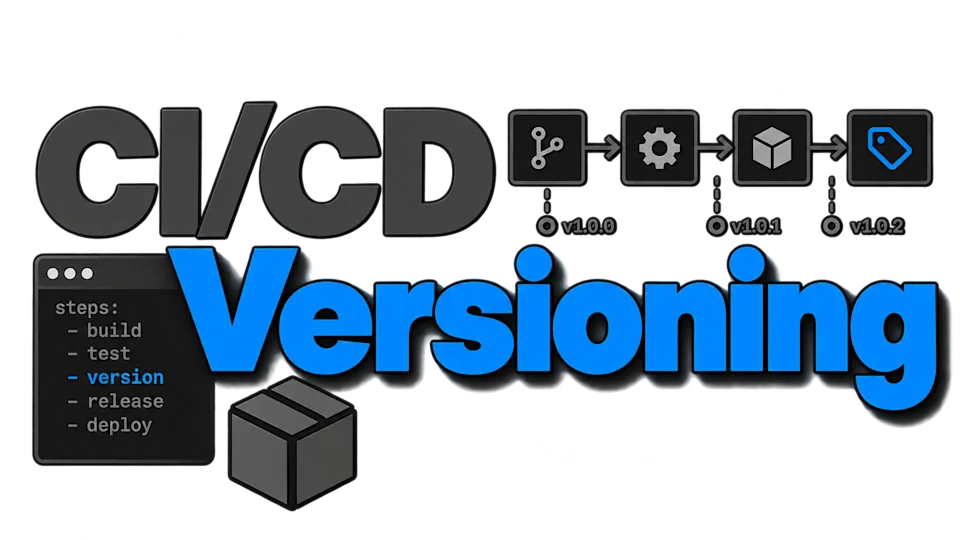
Stop Cutting Releases by Hand: A Versioning Pipeline That Refuses to Guess
Here is the release checklist almost every project writes down and almost nobody follows:
- Decide the new version number.
- Bump it in the backend source file.
- Bump it in
package.json. - Write the changelog entry.
- Commit, tag, push.
- Build and push the container image.
- Build the distributable archive.
- Write release notes.
- Upload the assets.
Nine steps, each one a place to drop the ball. The failure modes are boringly predictable: you bump one of the two version files and ship an image labelled 2.4.0 whose health endpoint still reports 2.3.0. You tag, then the image build fails, and now a tag exists that nothing was ever built from. You write the changelog three weeks later from memory, and it reads like it.
This post walks through a pipeline that does all nine steps on every merge to main, and - more importantly - the failure modes it was hardened against. The snippets are deliberately generic: plain bash and awk you can drop into any project, with a per-ecosystem adapter table for the one part that differs. At the end there is a trimmed copy-paste workflow.
The production case study is DockRadar, a Docker container monitor that ships a container image to two registries and a native install tarball for Linux and macOS on every release - currently at v13.19.5, after 31 tagged releases. Every "in production this is…" pointer below refers to .github/workflows/release.yml in that repo.
Two rules the whole design rests on
Everything below follows from two rules. If you take nothing else from this post, take these.
Rule 1 - one source of truth per artifact, and a machine that copies it.
A version number that lives in four files is four opportunities for drift. Pick exactly one home per build artifact (one per language runtime, usually), and let automation write the others. Then verify the copy landed - more on that in Stage 2, because this is the step everyone skips.
In DockRadar there are two sources of truth, one per runtime: backend/app/version.py holds a bare __version__ = "X.Y.Z" - nothing else in the file, so the rewrite pattern can stay trivial - and frontend/package.json holds the version field. The API serves __version__ back to the UI, so a missed bump is visible to every user, not just to whoever cut the release.
Rule 2 - nothing irreversible until everything reversible has passed.
Order your pipeline by how hard each step is to undo:
| Step | Undo cost |
|---|---|
| Rewrite a version string | free |
| Build an archive | free |
| Push a commit | cheap |
| Push a tag | expensive - consumers may already have fetched it |
Push :latest to a registry | expensive |
| Publish a GitHub Release | public immediately |
So everything free goes first. In DockRadar the native tarball is built and smoke-tested at release.yml:170 - a hundred lines before git tag at release.yml:284. A broken build fails the job while the only damage is a red X in the Actions tab. Get this ordering backwards and a compile error leaves behind a tag you now have to explain to everyone who already fetched it.
Stage 1 - Derive the version from commits you already wrote
You already encoded your intent when you wrote feat: or fix: in the commit subject. Read it back instead of asking a human to decide again.
# Latest released version, as a bare number. Requires the full tag list:# actions/checkout fetches no tags by default - use# with: { fetch-depth: 0, fetch-tags: true }LATEST=$(git tag -l 'v*' \ | grep -E '^v[0-9]+\.[0-9]+\.[0-9]+$' \ | sed 's/^v//' \ | sort -V \ | tail -1)Two details in those four lines are load-bearing:
sort -V, never plainsort. Version sort understands that 16 > 9; lexical sort does not. Run it yourself on13.8.0, 13.9.0, 13.10.0, 13.16.3-sort -V | tail -1gives13.16.3, plainsort | tail -1gives13.9.0. A pipeline using plainsortsilently starts computing bumps from the wrong base the moment you reach a two-digit minor.- The
grep -Efilter. Without it,v2.0.0-rc1orv2.0.0-hotfixcan win the sort and feed a non-numeric string into arithmetic. Decide what a release tag looks like and reject everything else.
Now the bump decision:
SUBJECTS=$(git log --format=%s "v$LATEST..HEAD") # subjects: feat:, fix:, type!:BODIES=$(git log --format=%B "v$LATEST..HEAD") # full bodies: BREAKING CHANGE footers if [ -z "$SUBJECTS" ]; then echo "::error::No commits since v$LATEST - nothing to release." exit 1fi if echo "$BODIES" | grep -qE '^BREAKING CHANGE' \|| echo "$SUBJECTS" | grep -qE '^[a-z]+(\([^)]*\))?!:'; then BUMP=major # feat!: or a BREAKING CHANGE footerelif echo "$SUBJECTS" | grep -qE '^feat(\([^)]*\))?:'; then BUMP=minorelse BUMP=patchfiBreaking changes get detected two ways, because Conventional Commits allows both: a ! before the colon in the subject, or a BREAKING CHANGE: footer in the body. Checking only subjects misses half of them. The (\([^)]*\))? group is what makes feat(api): count as a feature rather than falling through to "other".
Then the arithmetic, which is one line of shell and needs no dependencies at all:
IFS=. read -r MA MI PA <<< "$LATEST"case "$BUMP" in major) VERSION="$((MA+1)).0.0" ;; minor) VERSION="$MA.$((MI+1)).0" ;; patch) VERSION="$MA.$MI.$((PA+1))" ;;esac
<<<is a bash here-string, and so are thearray=()forms later in this post. GitHub Actions' default shell onubuntu-latestisbash, so these work as written - but they are not POSIXsh. If you port this to a container whose/bin/shis dash, setshell: bashexplicitly.
Refuse rather than guess
The most valuable property of a release pipeline is that it stops when reality does not match its assumptions. Three guards, each two lines:
# 1. An explicitly requested version must actually be semver.if [[ ! "$EXPLICIT" =~ ^[0-9]+\.[0-9]+\.[0-9]+$ ]]; then echo "::error::Version must be semver like 2.1.0 (got '$EXPLICIT')"; exit 1fi # 2. Never re-release an existing tag.if git tag -l "v$VERSION" | grep -q .; then echo "::error::Tag v$VERSION already exists"; exit 1fi # 3. Never go backwards - catches typos like 2.1.0 when 2.10.0 is out.HIGHEST=$(printf '%s\n%s\n' "$LATEST" "$VERSION" | sort -V | tail -1)if [ "$HIGHEST" != "$VERSION" ]; then echo "::error::Version $VERSION is not higher than the latest release $LATEST"; exit 1fiGuard 3 is the one people leave out, and the one that saves you. 2.1.0 typed instead of 2.10.0 is a plausible slip, passes a semver regex, and publishes a "new" release that every package manager and update checker will consider older than what users already have.
Keep the manual override
Automation that cannot be overridden gets worked around. Expose both modes on the same job:
on: workflow_dispatch: inputs: version: description: 'Explicit version without the leading v (empty = auto-calculate)' required: false type: string bump: description: 'Auto-calculation mode when version is empty' default: auto type: choice options: [auto, major, minor, patch]One wrinkle worth knowing: when the same job is also triggered by something other than workflow_dispatch, every inputs.* expression renders as an empty string. Default them in shell, or the first automatic run picks an empty bump mode and dies:
BUMP="${{ inputs.bump }}"BUMP="${BUMP:-auto}" # inputs are empty on non-dispatch triggersIn production: release.yml:68-134.
Stage 2 - Bump every file, then prove the bump happened
Writing the version is one line per ecosystem. Here is the part that matters: sed exits 0 when it matches nothing. Rename the file, reformat the line, add a type annotation - __version__: str = "1.0.0" no longer matches ^__version__ = ".*" - and your bump step goes green while changing nothing. You then publish an image tagged 2.4.0 containing version 2.3.0, and you find out from a user.
So always pair the write with an independent read-back:
V="${{ steps.version.outputs.value }}" # --- write ---sed -i 's/^__version__ = ".*"/__version__ = "'"$V"'"/' pkg/version.py(cd frontend && npm pkg set version="$V") # --- prove it (read the files back through a different mechanism) ---APP_VERSION=$(sed -n 's/^__version__ = "\(.*\)"/\1/p' pkg/version.py)PKG_VERSION=$(node -p "require('./frontend/package.json').version")echo "release=$V backend=$APP_VERSION frontend=$PKG_VERSION"if [ "$V" != "$APP_VERSION" ] || [ "$V" != "$PKG_VERSION" ]; then echo "::error::Version bump failed - backend '$APP_VERSION' / frontend '$PKG_VERSION' do not match '$V'" exit 1fiFour extra lines, and the class of bug "we shipped a mislabelled build" is gone for good.
Write / read-back pairs per ecosystem
| Ecosystem | Write | Read back |
|---|---|---|
| Node | npm pkg set version="$V" | node -p "require('./package.json').version" |
Python (bare __version__) | sed -i 's/^__version__ = ".*"/__version__ = "'"$V"'"/' pkg/version.py | sed -n 's/^__version__ = "\(.*\)"/\1/p' pkg/version.py |
Python (pyproject.toml) | sed -i '0,/^version =/s/^version = ".*"/version = "'"$V"'"/' pyproject.toml | python -c "import tomllib,pathlib;print(tomllib.loads(pathlib.Path('pyproject.toml').read_text())['project']['version'])" |
| Rust | cargo set-version "$V" (cargo-edit) | cargo metadata --no-deps --format-version 1 | jq -r '.packages[0].version' |
| Go | nothing to bump - inject at build: -ldflags "-X main.version=$V" | ./myapp --version |
| Java / Maven | mvn -q versions:set -DnewVersion="$V" -DgenerateBackupPoms=false | mvn -q help:evaluate -Dexpression=project.version -DforceStdout |
| .NET | sed -i "s#<Version>.*</Version>#<Version>$V</Version>#" MyApp.csproj | dotnet msbuild -getProperty:Version |
The Go row is the ideal, incidentally: there is nothing to bump because nothing is committed. If your language lets you inject the version at build time, this whole class of drift disappears and the tag is the only source of truth you need.
A second, independent gate at tag time
The check above runs inside the release job, where the version came from a variable, so it mostly proves sed worked. Add an independent gate in whatever workflow builds images from tags, where the version arrives from a completely different source - the git ref:
- name: Verify version consistency (tag builds only) if: startsWith(github.ref, 'refs/tags/v') run: | TAG_VERSION="${GITHUB_REF_NAME#v}" APP_VERSION=$(sed -n 's/^__version__ = "\(.*\)"/\1/p' pkg/version.py) if [ "$TAG_VERSION" != "$APP_VERSION" ]; then echo "::error::Version mismatch - tag v$TAG_VERSION, code $APP_VERSION. Bump before tagging." exit 1 fiThis one catches the human path: someone tags v2.5.0 by hand from a laptop without bumping anything. Two cheap checks from two different angles beat one clever check.
In production: release.yml:136-154 and docker-publish.yml:37-47.
Stage 3 - Rotate the changelog instead of writing one
Adopt the Keep a Changelog layout and treat ## [Unreleased] as an inbox:
# Changelog ## [Unreleased] ## [2.3.0] - 2026-04-02 ### Added- Thing you can now do [Unreleased]: https://github.com/you/myapp/compare/v2.3.0...HEAD[2.3.0]: https://github.com/you/myapp/compare/v2.2.0...v2.3.0Release time is then pure text surgery, and the policy that makes it pleasant to live with is:
If a human wrote notes under
[Unreleased], use them verbatim. If nobody did, synthesize them from the commit log.
Best of both: prose when a change deserves prose, never a blank release when it does not. Extract the current body first:
# awk: print the lines between the [Unreleased] heading and the next "## [" heading/^## \[Unreleased\]/ { grab=1; next }grab && /^## \[/ { exit }grab { print }If that comes back empty, group the commit subjects instead:
RANGE="v$LATEST..HEAD"subj() { git log --no-merges --format='%s' "$RANGE"; } ADDED=$(subj | grep -E '^feat(\([^)]*\))?:' | sed -E 's/^feat(\([^)]*\))?: *//')FIXED=$(subj | grep -E '^fix(\([^)]*\))?:' | sed -E 's/^fix(\([^)]*\))?: *//')CHANGED=$(subj | grep -viE '^(feat|fix)(\([^)]*\))?:' \ | grep -viE '^chore\(release\)' \ | sed -E 's/^[a-zA-Z]+(\([^)]*\))?: *//') : > section_body.txtadd_group() { # add_group "Added" "$ADDED" [ -n "$2" ] || return 0 # skip empty groups - no bald "### Fixed" headings { printf '\n### %s\n' "$1"; printf '%s\n' "$2" | sed 's/^/- /'; } >> section_body.txt}add_group Added "$ADDED"add_group Fixed "$FIXED"add_group Changed "$CHANGED" # Never emit an empty section.grep -qE '\S' section_body.txt || printf '\n- Maintenance release.\n' >> section_body.txt--no-merges keeps "Merge pull request #24" out of your release notes. Excluding chore(release) keeps the previous release commit from showing up in the next release's notes - a small thing that looks sloppy on every release page until you fix it.
Then splice: re-emit an empty [Unreleased], insert the new dated section, and drop the old body.
# awk -v ver=2.4.0 -v date=2026-04-02 -v bodyfile=section_body.txt/^## \[Unreleased\]/ && !done { print "## [Unreleased]"; print ""; # leave a fresh, empty inbox print "## [" ver "] - " date; while ((getline line < bodyfile) > 0) print line; print ""; done=1; skip=1; next # skip = swallow the old body}skip && /^## \[/ { skip=0 } # next heading: stop swallowingskip { next }{ print }And refresh the reference links in one more pass - repoint [Unreleased] at the new tag and insert the new version's compare link above the rest:
# awk -v ver=2.4.0 -v latest=2.3.0 -v repo=you/myapp/^\[Unreleased\]:/ { print "[Unreleased]: https://github.com/" repo "/compare/v" ver "...HEAD" print "[" ver "]: https://github.com/" repo "/compare/v" latest "...v" ver next}{ print }One trick worth stealing when you later extract that section for the release body: match with index() rather than a regex.
# "## [2.4.0]" as a literal prefix - no escaping the [brackets], no regex surprisesindex($0, "## [" ver "]") == 1 { grab=1; next }grab && index($0, "## [") == 1 { exit }grab { print }Interpolating a version into a regex means escaping [, ] and . correctly every single time. index($0, s) == 1 is a literal prefix test, and it is impossible to get wrong.
In production: release.yml:201-282.
Stage 4 - Commit, tag and push atomically
git config user.name "github-actions[bot]"git config user.email "41898282+github-actions[bot]@users.noreply.github.com" git add pkg/version.py frontend/package.json CHANGELOG.mdgit commit -m "chore(release): v$V"git tag "v$V" # --atomic: branch and tag land together, or neither does.git push --atomic origin HEAD "v$V"--atomic is the important word. Here is the exact scenario it prevents: your release job starts, and while it is building, a teammate merges another PR. Your branch push is now rejected as non-fast-forward. Without --atomic, git has already pushed the tag - so the remote carries v2.4.0 pointing at a commit that is not on main and never will be, and your release references a version bump nobody can see. With --atomic, the rejection takes the tag down with it and the job fails clean; you re-run it and it recalculates from the new main.
Pair it with serialized concurrency:
concurrency: group: release cancel-in-progress: false # queue releases; never cancel one mid-flightcancel-in-progress: true is the right default for CI on pull requests and the wrong default here. A cancelled release job is a release stopped at a random line - tag pushed, image not built; image pushed, release not created. Releases should queue and run to completion, however slow that feels.
In production: release.yml:46-50 and release.yml:284-293.
Stage 5 - Publish artifacts, and the part everyone gets wrong
This is the stage that bit DockRadar in production, three releases in a row, and the lesson generalizes to any release tool.
softprops/action-gh-release - and most equivalents - does this internally:
- create the release as a draft,
- upload each asset,
- flip
draft: falseto publish.
Sensible. But if step 2 throws, the job dies before step 3, and the release stays a draft. Drafts are invisible to everyone but maintainers. Meanwhile the tag is pushed and the image is on the registry. So v13.16.0, v13.16.1 and v13.16.2 all "shipped" with an invisible release page - and GitHub's upload endpoint turned out to be the culprit: sporadic server-side errors (Error saving asset, Error creating asset temp dir) that hit assets of any size. v13.16.2 failed on install.sh, a few kilobytes.
The general principle:
Publish the cheap thing that cannot fail first. Attach the expensive things afterwards.
# 1. Create the release with a body and NO assets. Nothing here can fail# transiently, so the release always becomes visible.- name: Create GitHub Release uses: softprops/action-gh-release@v3 with: tag_name: v${{ steps.version.outputs.value }} name: v${{ steps.version.outputs.value }} body_path: RELEASE_NOTES.md generate_release_notes: true # appends commits + contributors # 2. Attach assets separately, with retries.- name: Upload release assets env: GH_TOKEN: ${{ secrets.GITHUB_TOKEN }} TAG: v${{ steps.version.outputs.value }} run: | upload() { for attempt in 1 2 3 4 5; do # Quiet on the first try; every retry dumps the full HTTP exchange, so a # recurring failure is diagnosable from the log alone - status code plus # the x-github-request-id header, which is what support will ask for. [ "$attempt" -gt 1 ] && export GH_DEBUG=api # --clobber makes each attempt idempotent: a retry after a partial # upload replaces the asset instead of duplicating it. if gh release upload "$TAG" "$1" --clobber; then echo "attached $1 (attempt $attempt)"; unset GH_DEBUG; return 0 fi echo "attempt $attempt failed for $1" [ "$attempt" -lt 5 ] && sleep $((attempt * 15)) # 15s, 30s, 45s, 60s done unset GH_DEBUG; return 1 }Three ideas in that function are worth lifting wholesale:
- Idempotent retries.
--clobber(or your tool's equivalent upsert flag) means attempt 4 does not care what attempts 1–3 half-did. Retry logic without idempotency creates duplicates. - Escalating observability. Debug logging off on the happy path, on from attempt 2. Healthy runs stay readable; the one run you need to debug carries everything. (Actions masks
GITHUB_TOKENin all log output, soGH_DEBUG=apidoes not leak it - verify the equivalent guarantee before doing this on another platform.) - Linear backoff, bounded attempts. Five tries over about two and a half minutes. Long enough to outlive a blip, short enough that a real outage fails the job instead of burning runner minutes.
Not every asset deserves to fail the release
Classify assets by whether their absence actually breaks a user:
# Required: the install instructions in the release notes curl these by URL,# so a release missing them is genuinely broken.failed=()for f in "$NATIVE" "$NATIVE.sha256" scripts/install.sh scripts/uninstall.sh; do upload "$f" || failed+=("$f")done # Best effort: the image is already on both registries, so a missing *offline*# tarball must not fail an otherwise-complete release. Warn, and leave the# operator the exact recovery commands.if ! upload "$IMAGE_TARBALL"; then echo "::warning::Could not attach $IMAGE_TARBALL. $TAG is published and the image is on GHCR and Docker Hub." { echo "### Offline image tarball not attached" echo "To attach it by hand:" echo " docker pull $IMAGE && docker save $IMAGE | gzip > $IMAGE_TARBALL" echo " gh release upload $TAG $IMAGE_TARBALL --clobber" } >> "$GITHUB_STEP_SUMMARY"fi if [ ${#failed[@]} -gt 0 ]; then echo "::error::Required assets failed to upload after 5 attempts: ${failed[*]}" exit 1fiWriting recovery commands into $GITHUB_STEP_SUMMARY is a habit worth forming. When a partial failure happens, the person fixing it is already looking at the run page - put the fix there, pre-filled with the real version and image name, instead of making them reconstruct it from the workflow source.
In production: release.yml:390-463. The comment block above that step names the three releases it came from; incident notes belong next to the code that carries the scar.
Stage 6 - Smoke-test what you actually shipped
A successful build proves your code compiles and your Dockerfile has valid syntax. It does not prove the thing you are about to publish runs. Two checks, seconds each, catch an embarrassing share of bad releases.
Check the packaged archive, not the working tree. Install it into a throwaway environment from the packaged dependency list and import the app. This catches the file you forgot to include and the dependency that only exists in your dev requirements:
python -m venv /tmp/smoke-venv/tmp/smoke-venv/bin/pip install --quiet -r "dist/$STAGE/backend/requirements.txt"(cd "dist/$STAGE/backend" && /tmp/smoke-venv/bin/python -c \ "import app.main as m; assert m.DIST.exists(), 'frontend/dist missing'; print('smoke test ok')")That assert m.DIST.exists() is the good part: it verifies the built frontend made it into the archive. An archive that imports fine but serves a blank page is exactly the failure a plain import test misses.
Check the pushed image, not the local build. Pull it back from the registry and run one command in it:
docker pull "$IMAGE"docker run --rm "$IMAGE" python -c "import app.main; print('smoke test: app imports ok')"Generalize as docker run --rm "$IMAGE" myapp --version for a compiled binary, or node -e "require('./dist/index.js')" for Node. The rule: the build proves it compiles; only running it proves it loads.
In production: release.yml:191-194 and release.yml:343-358.
Wiring the triggers
DockRadar chains three workflows instead of running one giant one:
PR opened ──────────────► ci.yml (tests + frontend build) │ workflow_callpush to main ───────────► docker-publish.yml (needs: ci → build & push :latest) │ workflow_run: completed release.yml (version → bump → changelog → tag → versioned image → release)ci.yml is written with on: workflow_call and on: pull_request, so one file serves as both the PR gate and the reusable quality gate the publish workflow depends on via needs:. No duplicated test configuration.
One GitHub-specific gotcha that will cost you an afternoon if you do not know it:
A tag pushed using
GITHUB_TOKENdoes not trigger other workflows.
This is deliberate - it stops a workflow from triggering itself forever. But it means a release.yml that pushes v2.4.0 and expects the tag-triggered image build to fire will wait forever. Two ways out:
- Build the versioned image inside the release job - what DockRadar does at
release.yml:309-338, reusingdocker/metadata-actionto tag bothX.Y.Zandlatest. No extra credentials, and one job you can read top to bottom. - Push the tag with a PAT or GitHub App token, which does trigger workflows. More moving parts, a secret to rotate, and a genuine self-trigger loop risk.
Option 1 is the safer default. Whichever you pick, write down why in a comment at the top of the workflow - this is exactly the kind of thing that looks like a redundant duplicate build to whoever reads it next. (On GitLab CI the equivalent chaining is needs: plus rules: - if: $CI_COMMIT_TAG; on Jenkins it is a downstream build job: step. The token gotcha is GitHub-specific, but "does my tag push retrigger the pipeline?" is a question worth answering explicitly on every platform.)
The copy-paste version
A minimum viable pipeline with every principle above and none of the project specifics. Fill in the two TODO markers.
name: Release on: workflow_dispatch: inputs: version: { description: 'Explicit X.Y.Z (empty = auto)', required: false, type: string } bump: description: 'Mode when version is empty' default: auto type: choice options: [auto, major, minor, patch] permissions: contents: write # commit, tag, create release packages: write # only if you push images concurrency: group: release cancel-in-progress: false jobs: release: runs-on: ubuntu-latest steps: - uses: actions/checkout@v5 with: { fetch-depth: 0, fetch-tags: true } # both required for tag math - name: Determine version id: version run: | EXPLICIT="${{ inputs.version }}" BUMP="${{ inputs.bump }}"; BUMP="${BUMP:-auto}" LATEST=$(git tag -l 'v*' | grep -E '^v[0-9]+\.[0-9]+\.[0-9]+$' \ | sed 's/^v//' | sort -V | tail -1) if [ -n "$EXPLICIT" ]; then [[ "$EXPLICIT" =~ ^[0-9]+\.[0-9]+\.[0-9]+$ ]] \ || { echo "::error::Not semver: $EXPLICIT"; exit 1; } VERSION="$EXPLICIT" else [ -n "$LATEST" ] || { echo "::error::No v* tags; pass an explicit version"; exit 1; } if [ "$BUMP" = auto ]; then S=$(git log --format=%s "v$LATEST..HEAD"); B=$(git log --format=%B "v$LATEST..HEAD") [ -n "$S" ] || { echo "::error::No commits since v$LATEST"; exit 1; } if echo "$B" | grep -qE '^BREAKING CHANGE' \ || echo "$S" | grep -qE '^[a-z]+(\([^)]*\))?!:'; then BUMP=major elif echo "$S" | grep -qE '^feat(\([^)]*\))?:'; then BUMP=minor else BUMP=patch; fi fi IFS=. read -r MA MI PA <<< "$LATEST" case "$BUMP" in major) VERSION="$((MA+1)).0.0" ;; minor) VERSION="$MA.$((MI+1)).0" ;; patch) VERSION="$MA.$MI.$((PA+1))" ;; esac fi git tag -l "v$VERSION" | grep -q . && { echo "::error::v$VERSION exists"; exit 1; } if [ -n "$LATEST" ]; then [ "$(printf '%s\n%s\n' "$LATEST" "$VERSION" | sort -V | tail -1)" = "$VERSION" ] \ || { echo "::error::$VERSION is not newer than $LATEST"; exit 1; } fi echo "value=$VERSION" >> "$GITHUB_OUTPUT" echo "latest=$LATEST" >> "$GITHUB_OUTPUT" echo "## Releasing v$VERSION" >> "$GITHUB_STEP_SUMMARY" # TODO: replace with your ecosystem's write + read-back pair (see the table above). - name: Bump and verify run: | V="${{ steps.version.outputs.value }}" sed -i 's/^__version__ = ".*"/__version__ = "'"$V"'"/' pkg/version.py GOT=$(sed -n 's/^__version__ = "\(.*\)"/\1/p' pkg/version.py) [ "$V" = "$GOT" ] || { echo "::error::bump failed: got '$GOT'"; exit 1; } # TODO: build + smoke-test your artifacts HERE - before the tag exists. - name: Rotate changelog run: | # See Stage 3: extract [Unreleased], fall back to commit-derived # bullets, splice in "## [X.Y.Z] - DATE", refresh the compare links, # and write RELEASE_NOTES.md. echo "TODO" - name: Commit, tag, push run: | V="${{ steps.version.outputs.value }}" git config user.name "github-actions[bot]" git config user.email "41898282+github-actions[bot]@users.noreply.github.com" git add -A && git commit -m "chore(release): v$V" git tag "v$V" git push --atomic origin HEAD "v$V" - name: Create release (no assets - cannot fail transiently) uses: softprops/action-gh-release@v3 with: tag_name: v${{ steps.version.outputs.value }} name: v${{ steps.version.outputs.value }} body_path: RELEASE_NOTES.md generate_release_notes: true - name: Upload assets with retries env: GH_TOKEN: ${{ secrets.GITHUB_TOKEN }} TAG: v${{ steps.version.outputs.value }} run: | upload() { for attempt in 1 2 3 4 5; do [ "$attempt" -gt 1 ] && export GH_DEBUG=api gh release upload "$TAG" "$1" --clobber && { unset GH_DEBUG; return 0; } [ "$attempt" -lt 5 ] && sleep $((attempt * 15)) done unset GH_DEBUG; return 1 } failed=() for f in dist/*.tar.gz; do upload "$f" || failed+=("$f"); done [ ${#failed[@]} -eq 0 ] || { echo "::error::failed: ${failed[*]}"; exit 1; }When not to build this
Honesty about the price: DockRadar's release.yml is about 460 lines of YAML and shell. That is real code, in a language with no type checker, that runs only in CI. Reach for an existing tool instead when:
- You want conventions, not decisions. release-please, semantic-release and changesets all do version calculation and changelog generation well, and someone else maintains them.
- Your artifacts are standard. Publishing to npm, PyPI or crates.io? The ecosystem tool already knows how. Shipping Go binaries? goreleaser is excellent and handles cross-compilation, checksums and archives in a few lines of config.
- Your team will not read shell. A 460-line workflow nobody else can debug is a bus-factor problem dressed up as automation.
Hand-rolling earns its keep when you need things the tools do not give you cheaply: a specific ordering guarantee (build, then tag), multi-artifact fan-out to different destinations (two registries and a native tarball and installer scripts), per-asset failure semantics (required vs best-effort), or a refusal to add a Node toolchain to a repo that has no other reason for one.
And you can mix: let release-please compute the version and changelog, then do your own artifact publishing with the retry and classification logic from Stage 5. These principles are independent of who implements each stage.
The checklist
- One source of truth per artifact - everything else is generated.
- Verify every bump by reading the file back. A
sedthat matched nothing still exits 0. - Build and smoke-test before you tag. The tag is the first step you cannot take back.
- Push branch and tag with
--atomic. Never leave an orphaned tag behind. - Queue releases; never cancel them.
cancel-in-progress: false. - Guard against going backwards, not just against malformed input.
- Publish first, attach second. Never let an asset upload strand the release.
- Retry idempotently, log more on retry, and classify assets as required or best-effort.
- Smoke-test the artifact you actually shipped, pulled back from where you shipped it.
- Comment the why, especially the scars.
# this is why the release job builds its own imagesaves the next person a day.
The pipeline you want is not the one that never fails. It is the one that, when it fails, leaves nothing behind that you have to explain.
The full workflow this was drawn from: release.yml in DockRadar - self-hosted Docker container monitoring. Every line reference in this post points there.
Happy coding! 👨💻
- ReleaseEngineering
- GitHubActions
- SemVer
- ConventionalCommits
- CICD
- DevOps
- Automation